
EL CINE COMO ARTE SUBVERSIVO
Amos Vogel
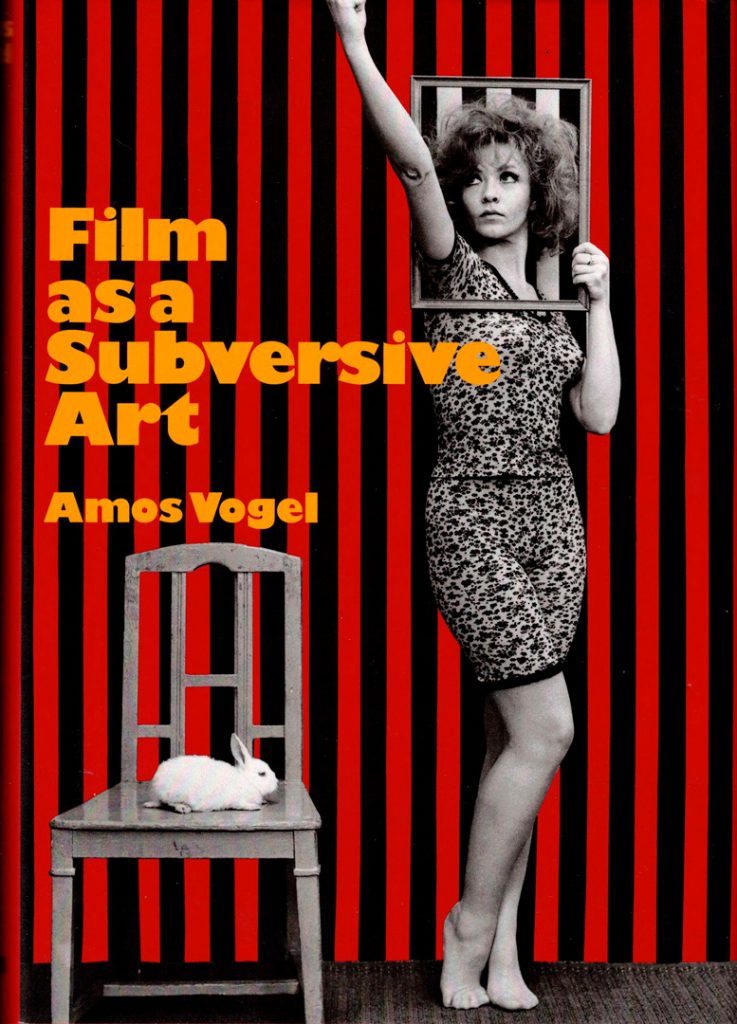
Este es un libro sobre la subversión de los valores, instituciones, costumbres y tabúes existentes (Oriente y Occidente, izquierda y derecha) por el arte con mayores posibilidades del siglo. Es un libro que mira con escepticismo todo el saber recibido (incluso el suyo propio), las verdades eternas, las reglas del arte, las leyes "naturales" y creadas por el hombre, e incluso todo lo que pueda considerarse sagrado. Es un intento de preservar durante un instante fugaz –la vida de este libro– las obras y logros de los subversivos del cine.
La subversión en el cine comienza cuando la sala se oscurece y la pantalla se ilumina. Porque el cine es un lugar mágico donde los factores psicológicos y ambientales se combinan para crear una apertura a lo asombroso y lo sugestivo, y para desbloquear el inconsciente. Es un santuario en el que rituales modernos arraigados en recuerdos atávicos y deseos subconscientes se representan en la oscuridad, en aislamiento respecto al mundo exterior.
El poder de la imagen, nuestro miedo a ella, la emoción que nos atrae hacia ella, es real. Aparte de cerrar los ojos (en el cine, un acto difícil y sin precedentes), no hay defensa contra ella.
Cuando el tren inmortal de Lumière llegó por primera vez a esa estación en 1895, avanzando directamente hacia la cámara, el público gritó; lo volvió a hacer cuando Buñuel cortó el globo ocular de una mujer con una navaja, cuando Clouzot hizo regresar literalmente a los muertos, cuando Hitchcock perpetró un asesinato repentino en una ducha, cuando Franju mató animales ante sus ojos. El público se desmayó en las películas de operaciones, vomitó en las escenas de partos, se entusiasmó espontáneamente con las películas de propaganda, lloró mientras la heroína moría lentamente de leucemia, gritó con ansiedad y placer durante la montaña rusa del Cinerama e incluso sintió punzadas de inquietud al verse expuesto a una epidemia de cólera en la pantalla. A la luz de estas reacciones manifiestas, ¿por qué asumir que otras de las innumerables fantasías soñadas en silencio en los cines del mundo durante los últimos setenta años (fantasías de lujuria, violencia, ambición, perversión, crimen y amor romántico) fueran a ser menos potentes?
"Es en el cine donde se celebra el único misterio absolutamente moderno", afirmó André Breton. Es apropiado que fuera un surrealista quien expresara tan bien la curiosa combinación de tecnología y metafísica que es el cine; porque la comprensión por parte de la ciencia moderna de un continuo que va de lo racional a lo irracional se relaciona directamente con la naturaleza misma del proceso de ver las películas. Esto implica una sala oscura, una mayor apertura a la sugestión, el trance semihipnótico del espectador, la aparición de deseos y ansiedades más profundos y la inhibición de una respuesta racional en favor de una reacción "instintiva". Lejos de representar una derrota en la lucha del hombre por la conciencia, la aceptación de esta inevitable dualidad (el flujo recíproco de racionalismo e irracionalidad) es en sí misma un paso adelante hacia el futuro.
Mauerhofer, Kracauer, Stephenson-Debrix y otros han analizado la mecánica del proceso de visión de las películas, aunque aún está pendiente un análisis exhaustivo. El espectador entra a la sala voluntariamente, si no con entusiasmo, dispuesto a entregarse (y profundamente insatisfecho si la película es "mala" y la ilusión no "funciona"). La experiencia cinematográfica requiere oscuridad total. El espectador no debe distraerse del brillante rectángulo desde el que grandes formas inciden sobre él. A diferencia de la experiencia de bajas presiones televisiva (durante la cual el espectador es consciente del ambiente de la habitación y de otras personas, ayudado por las bien denominadas "pausas"), la experiencia cinematográfica es total, inmersiva y alucinatoria. El espectador "olvida" dónde está o quién es, y le perturban las luces aisladas, los ruidos del público o de la calle que destruyen la ilusión esperada y aceptada.
En cuanto las luces se atenúan, el enorme rectángulo de la pantalla, antes visto sin interés, se convierte en el universo total del espectador. Lo que aquí se revela mediante estallidos de luz y oscuridad se acepta como la vida; las imágenes llegan hasta él; él penetra en ellas.
Los múltiples misterios del cine empiezan en este momento; la aceptación de una superficie plana como tridimensional, de cambios repentinos de acción, escala o escenario como algo ordinario, de una frontera que delimita este universo fraudulento como algo normal, del blanco y negro como realidad. El espectador, señala Rudolf Arnheim, no se sorprende al encontrar un mundo en el que la percepción de la profundidad ha sido alterada, los tamaños y las distancias se han aplanado y el cielo es del mismo color que el rostro humano.
Pero los misterios apenas acaban de empezar. La misma oscuridad que envuelve al espectador es más completa de lo que éste cree; porque la esencia del cine no es la luz, sino un pacto secreto entre la luz y la oscuridad. La mitad del tiempo que pasan en el cine las víctimas cautivadas de este arte tecnológico lo pasan en completa oscuridad. No hay ninguna imagen en la pantalla. En el transcurso de un solo segundo, cuarenta y ocho períodos de oscuridad siguen a cuarenta y ocho períodos de luz.
Durante este mismo período infinitesimal, cada imagen se muestra al público dos veces; y como fotografía fija; porque la película se detiene en seco en el proyector cuarenta y ocho veces en el transcurso de un solo segundo. Dada la incapacidad de la retina para adaptarse con rapidez a las diferencias de brillo, esta rápida proyección en serie de fotografías fijas, cada una ligeramente diferente de la anterior, crea una ilusión de movimiento.
Así, durante la mitad del tiempo que pasa en el cine, el espectador no ve ninguna imagen; y en ningún momento hay movimiento. Sin la complicidad fisiológica y psicológica del espectador, el cine no podría existir.
La "ilusión" del cine –tan trivialmente invocada por los periodistas– se revela así como una red de engaño mucho más intrincada, que implica a la tecnología misma del proceso cinematográfico y a la naturaleza de las percepciones de sus víctimas. ¿Será precisamente durante los períodos de oscuridad total (45 de cada 90 minutos de película que vemos) cuando nuestro subconsciente voraz, recién nutrido por otra imagen provocativa, "absorbe" el significado más profundo de la obra y da rienda suelta a cadenas de asociaciones?
Es en este entorno extraño donde el espectador se deja invadir voluntariamente por imágenes fuertes, creadas y manipuladas por un director-mago que controla por completo su visión. Es cierto que toda visión, incluso la que no está dirigida, es dinámica y refleja, como subraya Arnheim, una invasión del organismo por fuerzas externas que alteran el equilibrio del sistema nervioso. Pero mientras que en la vida cotidiana el espectador puede cambiar su foco de atención cuando lo desee (sin perder el sentido de continuidad con respecto a su entorno), en el cine su atención está "fijada" en una sucesión predeterminada de imágenes, cuya naturaleza, tempo, secuencia y duración han sido cuidadosamente diseñadas para conseguir el máximo impacto por parte de un tercero.
Alejado del mundo real, aislado incluso de los demás espectadores, el espectador cae en sueños y ensoñaciones en la oscuridad uterina de la sala. Inundado de imágenes, su inconsciente se libera de las limitaciones habituales y sus facultades racionales se inhiben. Stephenson y Debrix señalan que, excepto la vista y el oído, el cuerpo y otros sentidos están en reposo en el cine, lo que permite que la imaginación, estimulada por el material expresamente seleccionado y cargado de emociones por el cineasta, ejerza una influencia más profunda y duradera. Mauerhofer se refiere a la pasividad voluntaria y la receptividad acrítica del espectador; y Kracauer enfatiza la vacilación dialéctica entre el ensimismamiento (alejar al espectador de la imagen, hacia asociaciones personales desencadenadas por ella) y el abandono de sí mismo (el movimiento hacia la imagen). Quizás el espectador (en esto coinciden Mauerhofer, el psicólogo, y Breton, el surrealista) se sitúe casi entre la vigilia y el sueño, en ese estado en que abandona la racionalidad de la vida diaria sin entregarse aún por completo a su inconsciente.
Y la imagen es potente; no puede apartarse de ella. Porque el ser humano, tal vez en respuesta a un recuerdo atávico de miedo o alegría infantil, no puede resistirse a la atracción del movimiento (cuando entra en una sala o en un cine, sus ojos se sienten inevitablemente atraídos por las formas en movimiento). No puede "resistirse" a los vivos cambios producidos por el montaje, la repentina intrusión de formas en el encuadre, las ráfagas en cascada de imágenes que pasan a un ritmo más rápido que la vida, la potencia sensual del primer plano que se cierne sobre él. Es mucho más fácil despegarse de la acción en una obra de teatro. Aquí el espectador ha aceptado su irrealidad (así como aceptó la "realidad" de la película) y como sabe que ésta no puede "alcanzarlo" y atacarlo, nunca retrocede ante el escenario como lo hace ante la violencia en la pantalla. En ambos casos, el muerto se alza para ser asesinado otra vez. Pero el cine está "más cerca" del espectador: extraño tributo a la capacidad de un cerebro al que afectan más los reflejos bidimensionales sobre lienzos planos que los actores vivos actuando en un espacio tridimensional.
Y también es un tributo a la potencia de lo visual en cuanto tal. Porque, en la evolución humana, las imágenes son anteriores a las palabras y al pensamiento, alcanzando así capas más profundas, más antiguas y más básicas del yo. El ser humano empieza con lo que ve y avanza hacia las representaciones visuales de la realidad. Su transmutación en arte no parece reducir el impacto de las imágenes. Tan sagrada hoy como en la prehistoria, la imagen se acepta como si fuera vida, realidad, verdad. Se la acepta desde el sentimiento, más que desde la razón. Es significativo que solo si la "suspensión de la incredulidad" se rompe por la insatisfacción ante una determinada película el espectador sale de su estado de hipnosis.
Y sin embargo, por "auténtica" que sea la imagen, sigue siendo una distorsión de la vida. No solo carece de profundidad o densidad, de la continuidad del espacio-tiempo y del carácter no selectivo de la realidad, sino que acentúa ciertos aspectos excluyendo otros, y los aísla dentro de un marco fijo en una constante evolución de blancos y negros, objetos y fondos. Esta invocación mágica de imágenes concretas que aparentemente reflejan la realidad, pero en realidad la distorsionan, genera una tensión adicional entre la película y el espectador; aumenta su sensación de dislocación e inquietud, y permite avanzar aún más hacia su subconsciente, cada vez más vulnerable.
Es la emoción que generan estas imágenes brillantes que se mueven en un espacio oscuro y un tiempo artificial, su afinidad con el trance y el subconsciente, y su capacidad para influir en las masas y saltar límites, lo que siempre ha convertido al cine en objetivo de las fuerzas represoras de la sociedad: los censores, los conservadores de la tradición, el Estado. Aunque muchas veces esto ha dado como resultado la incapacidad para proyectar abiertamente las experiencias o percepciones humanas fundamentales, ni la represión ni el miedo parecen capaces de frenar la tendencia universal hacia un cine más liberado, en el que se exploran con audacia todos los motivos antes prohibidos. Esta evolución desde el tabú a la libertad es el tema de este libro.
FILM AS A SUBVERSIVE ART
This is a book about the subversion of existing values, institutions, mores, and taboos -- East and West, Left and Right -- by the potentially most powerful art of the century. It is a book that traffics in scepticism towards all received wisdom (including its own), towards eternal truths, rules of art, "natural" and man-made laws, indeed whatever may be considered holy. It is an attempt to preserve for a fleeting moment in time -- the life of this book -- the works and achievements of the subversives of film.
Subversion in cinema starts when the theatre darkens and the screen lights up. For the cinema is a place of magic where psychological and environmental factors combine to create an openness to wonder and suggestion, and unlocking of the unconcious. It is a shrine at which modern rituals rooted in atavistic memories and subconscious desires are acted out in darkness and seclusion from the outer world.
The power of the image, our fear of it, the thrill that pulls us toward it, is real. Short of closing one's eyes -- in cinema, a difficult and unprecedented act -- there is no defense against it.
When Lumiere's immortal train first pulled into that station in 1895, moving directly towards the camera, the audience shrieked. it did so again when Bunuel sliced a woman's eyeball with a razor, when Clouzot quite literally made the dead return, when Hitchcock committed sudden murder in a shower, when Franju killed animals before its eyes. The audience fainted during films of operations, vomited during birth sequences, rose in spontaneous enthusiasm at propaganda films, wept while the heroine died protractedly from leukemia, shouted with delicious anxiety during Cinerama's rollercoaster ride, and even felt twinges of concern at being exposed to screen cholera. In the light of these manifest responses, why assume that the count- less other fantasies dreamt in silence in the cinemas of the world during the last seventy years -- fantasies of lust, violence, ambition, perversion, crime, and romantic love -- were any less powerful?
"It is at the movies that the only absolutely modern mystery is celebrated", said Andre Breton. (1) It is appropriate that it was a surrealist who so well expressed the curious combination of technology and metaphysics that is cinema; for modern science's realization of a continuum from the rational to the irrational relates directly to the very nature of the film-viewing process. This entails a darkened theatre, greater openness to suggestion, the semi-hypnotic trance of the viewer, the surfacing of deeper desires and anxieties, and the inhibition of reasoned response in favor of "gut-level" reaction. Far from representing a defeat in man's struggle towards conciousness, the acceptance of this inevitable duality (the flowing into each other of rationalism and irrationality) is itself a step toward the future.
The mechanics of the film-viewing process have been discussed by Mauerhofer, Kracauer, Stephenson-Debrix and others, (2) though a comprehensive analysis remains to be undertaken. The viewer enters the theatre willingly, if not eagerly, ready for surrender, (and deeply dissatisfied if the film is "bad" and the illusion does not "work"). The film experience requires total darkness; the viewer must not be distracted from the bright rectangle from which huge shapes impinge on him. Unlike the low-pressure television experience (during which the viewer remains aware of room environment and other people, aided by appropriately named "breaks"), the film experience is total, isolating, hallucinatory. The viewer "forgets" where or who he is and is offended by stray light, street or audience noises which destroy the anticipated, accepted illusion.
As soon as the lights are lowered, the huge rectangle of the screen -- previously noted without interest -- becomes the viewer's total universe. What transpires here in bursts of light and darkness is accepted as life; the images reach out to him; he enters them.
The many mysteries of film begin at this moment; the acceptance of a flat surface as three-dimensional, of sudden action-, scale- or set-changes as ordinary, of a border delimiting this fraudulent universe as normal, of black- and-white as reality. The spectator, Rudolf Arnheim points out, (3) experiences no shock at finding a world in which depth perception has been altered, sizes and distances flattened and the sky is the same color as the human face.
But the mysteries are only beginning. The very darkness enveloping the viewer is more complete than he realizes; for the essence of cinema is not light, but a secret compact between light and darkness. Half of all the time at the movies is spent by the transfixed victims of this technological art in complete darkness. There is no image on the screen at all. In the course of a single second, forty-eight periods of darkness follow forty-eight periods of light.
During this same infinitesimal period, every image is shown to the audience twice; and as a still photograph; for the film comes to a dead stop in the projector forty-eight times in the course of a single second. Given the retina's inability to adjust quickly to differences in brightness, an illusion of movement is created by this rapid, stop-start series projection of still photographs, each slightly different from the one before.
Thus, during half the time spent at the movies, the viewer sees no picture at all; and at no time is there any movement. Without the viewer's physiological and psychological complicity, the cinema could not exist.
The "illusion" of film -- so platitudinously invoked by journalists -- is thus revealed as a far more intricate web of deception, involving the very technology of the film process and the nature of its victim's perceptions. Could it be precisely during the periods of total darkness -- 45 out of every 90 minutes of film we see -- that our voracious subconcious, newly nourished by yet another provocative image, "absorbs" the work's deeper meaning and sets off chains of associations?
It is in this alien environment that the viewer willingly permits himself to be invaded by strong images, created and manipulated by a director-magician who entirely controls his vision. True, all vision, even undirected, is dynamic, and reflects, as Arnheim emphasizes, an invasion of the organism by external forces which upset the balance of the nervous system. (4) But while in daily life the viewer can shift his focus of attention as he wishes (without losing a sense of continuity regarding his surroundings), in cinema his attention is "riveted" on a pre-ordained succession of images, whose nature, tempo, sequence, and duration have been carefully constructed for maximum impact by a third party.
Removed from the real world, isolated even from fellow-viewers, the spectator falls to dream and reverie in the womb-like darkness of the theatre. Flooded by images, his unconcious is freed from customary constraints and his rational faculties are inhibited. Stephenson and Debrix point out that except for seeing and hearing, body and other senses are at rest in the cinema, thus allowing imagination, stimulated by the filmmaker's emotionally charged, expressly-selected material, to exert deeper and more lasting influence. Mauerhofer refers to the viewer's voluntary passivity and uncritical receptivity; and Kracauer emphasizes the dialectical wavering between self-absorption (leading the viewer away from the image, into personal associations triggered by it) and self-abandonment (the movement toward the image). Perhaps the state of the viewer (as Mauerhofer, the psychologist, and Breton, the surrealist, both agree) is closest to that between waking and sleeping, in which he abandons the rationality of daily life while not yet completely surrendering to his unconcious.
And the image is powerful; he cannot turn from it. For man, perhaps in response to an atavistic memory of fear or child-like joy, cannot resist the attraction of movement (when he enters a room or cinema, his eyes are inevitably drawn to the moving shapes). He cannot "resist" the shocking changes caused by editing, the sudden intrusion of shapes into the frame, the cascading bursts of images flashing by at a rate faster than life,the sensuous power of the close-up looming over him. It is so much easier to turn from the action into a live play. Here the spectator has accepted its unreality (just as he accepted the film's "reality") and since he knows it cannot "reach out" and attack him, he never flinches from stage as he does from screen violence. In both cases, the murdered man rises to be killed another time; but cinema is "closer" to the viewer -- strange tribute to the faculties of a brain more affected by two-dimensional reflections on flat canvas than by live actors performing in three-dimensional space.
And it is a tribute to the power of visuals as such. For in man's evolution, images antedate words and thought, thus reaching deeper, older, more basic layers of the self. Man begins with what he sees, progressing to visual representations of reality. Their transmutation into art does not seem to diminish the images' impact. As holy today as in man's pre-history, the image is accepted as if it were life, reality, truth. it is accepted on a feeling - rather than mind- level. Significantly, it is only if the "suspension of disbelief" is broken by disssatisfaction with a given film that the viewer emerges from his hypnotized state.
And yet, however "authentic" the image, it remains a distortion of life. Not only does it lack depth or density, the space-time continuum, or the non-selectivity of reality, but it emphasizes certain aspects to the exclusion of others by isolation them within a fixed frame in a constantly evolving concatenation of blacks and whites, objects and grounds. This magical invocation of concrete images that seemingly reflects reality while actually distorting it, sets up additional tension between film and spectator; it increases his sense of dislocation and disquiet and permits further inroads into his ever more vulnerable subconcious.
It is the powerful impact of these brightly-lit images moving in black space and artificial time, their affinity to trance and the subconcious, and their ability to influence masses and jump boundaries, that has forever made the cinema an appropriate target of the repressive forces in society -- censors, traditionalists, the state. While the result has often been its inability openly to project fundamental human experiences or insights, neither repression nor fear seem able to stem an accelerating, world-wide trend towards a more liberated cinema, one in which all previously forbidden subjects are boldly explored. This evolution from taboo into freedom is the subject of this book.
(1) Andre Breton, quoted in J.H. Matthews, Surrealism and Film, 1971
(2) Hugh Mauerhofer, "Psychology of Film Experience", The Penguin Film Review, 1949 + Siegfried Kracauer, Theory of Film, 1960, + Ralph Stephenson and J.R. Debrix, The Cinema as Art, 1965.
(3) Rudolf Arnheim, Film as Art, 1933 / 1957
(4) Idem, Art and Visual Perception, 1965