CINEINFINITO / Centro Cultural Doctor Madrazo
Martes 13 de Agosto de 2024, 18:30h. Centro Cultural Doctor Madrazo
Calle Casimiro Sainz, s/n
39004 Santander
Programa:
– Dyketactics (1973), 16mm, sonora, color, 4 min.
– Sisters! (1974), 16mm, sonora, color, 9 min.
– Jane Brakhage (1975), 16mm, sonora, b&n, 10 min.
– The Great Goddess (1977), 16mm, sonora, b&n, 22 min.
– No No Nooky T.V. (1987), 16mm, sonora, color, 12 min.
– Sanctus (1990), 16mm, sonora, color, 19 min.
76 min.
Formato de proyección: HD
Barbara Hammer nació el 14 de mayo de 1939 en Hollywood, California. Es una artista visual que trabaja principalmente en cine y vídeo. Ha realizado más de 80 obras de imágenes en movimiento, a lo largo de una carrera de 40 años. Está considerada como una pionera del cine queer.
En 2013 obtuvo una beca Guggenheim para su película Waking Up Together (Despertando juntas) sobre la poeta Elizabeth Bishop. En ese mismo año fue elegida por la Fundación de Marie Walsh Sharpe para trabajar en la proyección de performance.
Hammer fue distinguida con una retrospectiva de un mes en el MoMA de Nueva York entre el 11 de septiembre y el 13 de octubre de 2010. En febrero de 2012 tuvo una retrospectiva también de un mes en la Tate Modern de Londres, seguida por otras en el Jeu de Paume de París en junio de 2012 y en el Festival Internacional de Cine de Toronto en octubre de 2013.
Como artista está representada por la Galería Koch Oberhuber Woolfe de Berlín, en la que realizó su primera exposición individual entre el 11 de febrero y el 17 de abril de 2011, y su tercera exposición de collages y dibujos en otoño de 2014.
Generations (2010, realizada con Gina Carducci) y Maya Deren’s Sink (2011), sus dos películas más recientes, ganaron el premio Teddy a los mejores cortometrajes en el Festival de Berlín de 2011. Sus películas experimentales de los años 70 tratan a menudo temas tabú tales como la menstruación, el orgasmo femenino y la sexualidad lésbica. En los 80 utilizó la técnica de la impresora óptica para explorar la percepción y la fragilidad de la vida misma de las películas de 16 mm. Optic Nerve (1985) y Endangered (1988) fueron seleccionadas por las bienales del Whitney Museum of American Art Biennials (1985, 1989, 1993).
En febrero de 2007 fue distinguida con un homenaje y retrospectiva en el Centro de Imagen Digital de la Universidad de Cultura China de Taipei (Taiwan), financiado por el festival de cine Women Make Waves. En 2008 se le concedió el premio Leo del Flaherty Film Seminar por su significativa contribución al cine documental. En abril de ese año, Diving Women of Jeju-do, presentada por Hammer, inauguró el Festival Internacional de Cine de Mujeres de Seúl, y después viajó a Pekín, donde proyectó sus películas lésbicas de los años 70 en un congreso feminista y en un nuevo centro LGTQ. En 2011 asistió al 10º Festival de Cine Queer de Pekín; también viajó a Shanghai y Xi’an para mostrar su obra en organizaciones pequeñas y sin financiación.
En marzo de 2010 su libro Hammer! Making Movies Out of Sex and Life, publicado por The Feminist Press de la Universidad de Nueva York fue lanzado con una performance en el Elizabeth A. Sackler Center for Feminist Art en el Museo de Arte de Brooklyn. La gira del libro en 2010 incluyó Hammer Museum (Los Angeles, California), The University of Michigan en Ann Arbor; el British Film Institute en Londres, el Experimental Film Congress en Toronto; el Departamento de Artes Visuales de San Diego de la Universidad de California, el Festival Crossroads de la San Francisco Cinematheque, el Northwest Film Center en el Portland Art Museum, y el Northwest Film Forum en Seattle (Washington).
Barbara Hammer da clases todos los veranos en la European Graduate School en Saas-Fee (Suiza). Vive y trabaja en Nueva York y Kerhonkson (New York).
Barbara Hammer was born on May 15, 1939 in Hollywood, California. She is a visual artist working primarily in film and video. She has made over 80 moving image works in a career that spans 40 years. She is considered a pioneer of queer cinema.
In 2013 she received a Guggenheim Fellowship for a film Waking Up Together on the poet Elizabeth Bishop. She was awarded the same year a Marie Walsh Sharpe artist studio to work on performance projection.
Hammer was honored with a month long retrospective at The Museum of Modern Art in New York City from September 11-October 13, 2010. In February 2012 she had a month long retrospective at The Tate Modern in London followed by retrospectives in Paris at Jeu de Paume in June 2012 and the Toronto International Film Festival in October 2013.
Her work is represented by the gallery Koch Oberhuber Woolfe in Berlin, Germany where her first solo exhibition ran from February 11-April 17, 2011 and her third exhibition of collages and drawings in fall 2014.
Generations, 2010 (made with Gina Carducci), and Maya Deren’s Sink, 2011, her two most recent films won the Teddy Award for Best Short Films at the 2011 Berlinale. Her experimental films of the 1970’s often dealt with taboo subjects such as menstruation, female orgasm and lesbian sexuality. In the 80’s she used optical printing to explore perception and the fragility of 16mm film life itself. Optic Nerve (1985) and Endangered (1988) were selected for the Whitney Museum of American Art Biennials (’85,’89,’93). Her documentaries tell the stories of marginalized peoples who have been hidden from history and are often essay films that are multi-leveled and engage audiences viscerally and intellectually with the goal of activating them to make social change. Nitrate Kisses (1992) was chosen for the 1993 Whitney Museum of American Art Biennial. Hammer was a Fulbright Senior Specialist in Fall 2005 at the Bratislava Academy of Art and Design, Slovakia; she received the first Shirley Clarke Avant-Garde Filmmaker Award in October 2006 from New York Women in Film and Television; and the Women In Film Award 2006 from the St. Louis International Film Festival.
In February 2007, she was awarded a tribute and retrospective at the Chinese Cultural University Digital Imaging Center in Taipei, Taiwan sponsored by Women Make Waves Film Festival. The Leo Award from the Flaherty Film Seminar was presented to her in 2008 for making a significant contribution to documentary film. In April of that year, Diving Women of Jeju-do premiered at the Seoul International Women’s Film Festival where Hammer presented followed by a trip to Beijing where she showed her 1970 lesbian films to a Feminist Seminar and at a new LGTQI Center. In 2011 she was a guest of the 10th Beijing Queer Film Festival. She also traveled to Shanghai and Xi’an to show work at small, unfunded organizations.
Hammer’s experimental documentary film on cancer and hope, A Horse Is Not A Metaphor, premiered in June, 2008 at the 32nd Frameline International Lesbian and Gay Film Festival in San Francisco and in February, 2009 at DocFortnight at the Museum of Modern Art, New York. It won the Teddy Award for Best Short Film at the 2009 Berlinale and Second Prize at the Black Maria Film Festival. It was selected for Punta de Vista Film Festival in Bilbao, Spain; the Torino Gay and Lesbian Film Festival in Italy; the International Women’s Film Festival Dortmund/Koln, and the Festival de Films des Femmes Creteil among others.
In March 2010 her book, Hammer! Making Movies Out of Sex and Life published by The Feminist Press at the City University of New York was launched in a performance at the Elizabeth A. Sackler Center for Feminist Art at Brooklyn Museum of Art, New York. A 2010 book tour included The Hammer Museum, Los Angeles, California; The University of Michigan at Ann Arbor; the British Film Institute in London, England; the Experimental Film Congress in Toronto, Canada; the University of California at San Diego Visual Arts Department; the San Francisco Cinematheque Crossroads Festival; the Northwest Film Center at the Portland Art Museum, and the Northwest Film Forum in Seattle, Washington.
She teaches each summer at The European Graduate School in Saas-Fee, Switzerland. Barbara Hammer lives and works in New York City and Kerhonkson, New York.

Dyketactics (1973)
"Las películas de Hammer de los años 70 son las primeras realizadas por una cineasta estadounidense abiertamente lesbiana que explora la identidad, el deseo y la sexualidad de las lesbianas a través de estrategias vanguardistas. Fusionando la fisicalidad del cuerpo femenino con la del medio cinematográfico, las películas de Hammer siguen siendo memorables por su articulación pionera de una estética lésbica". -¡Jenni Sorkin, WACK! Arte y revolución feminista
“Hammer’s films of the ’70’s are the first made by an openly lesbian American filmmaker to explore lesbian identity, desire and sexuality though avant-garde strategies. Merging the physicality of the female body with that of the film medium, Hammer’s films remain memorable for their pioneering articulation of a lesbian aesthetic.” -Jenni Sorkin, WACK! Art & The Feminist Revolution
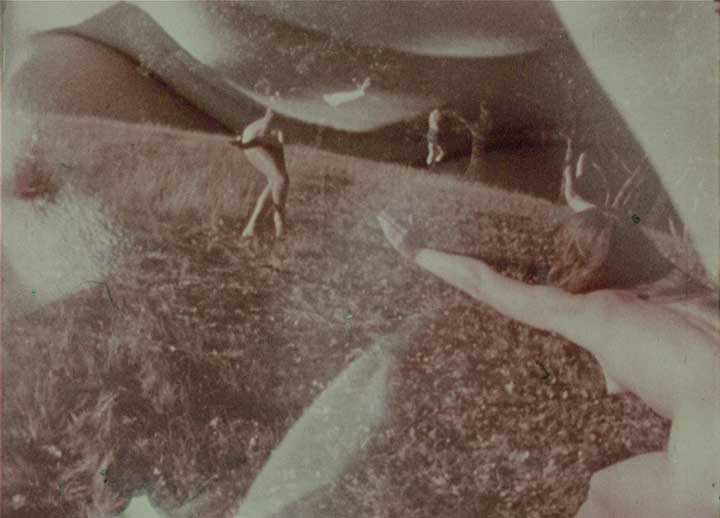
Sisters! (1974)
Una celebración y un collage de lesbianas, que incluye imágenes de la marcha del Día Internacional de la Mujer en SF y alegres bailes de la última noche de la segunda Conferencia de Lesbianas, donde actuó Family of Woman; así como imágenes de mujeres haciendo todo tipo de trabajos tradicionales "de hombres".
A celebration and collage of lesbians, including footage of the Women’s International Day march in SF and joyous dancing from the last night of the second Lesbian Conference where Family of Woman played; as well as images of women doing all types of traditional “men’s” work.
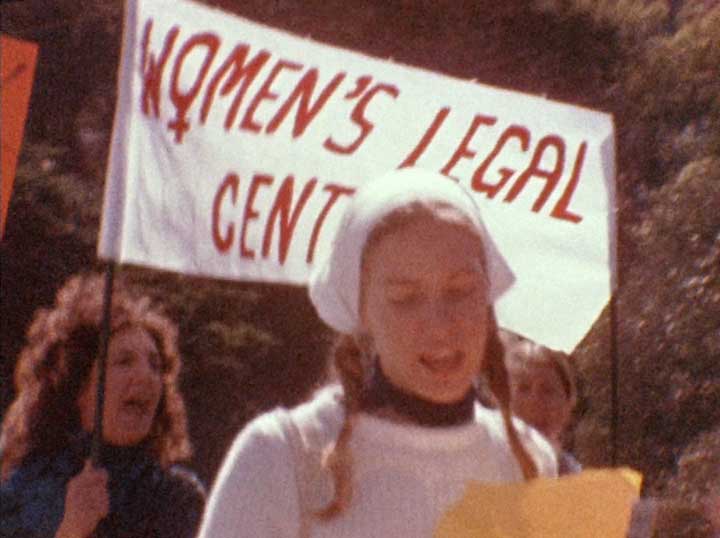
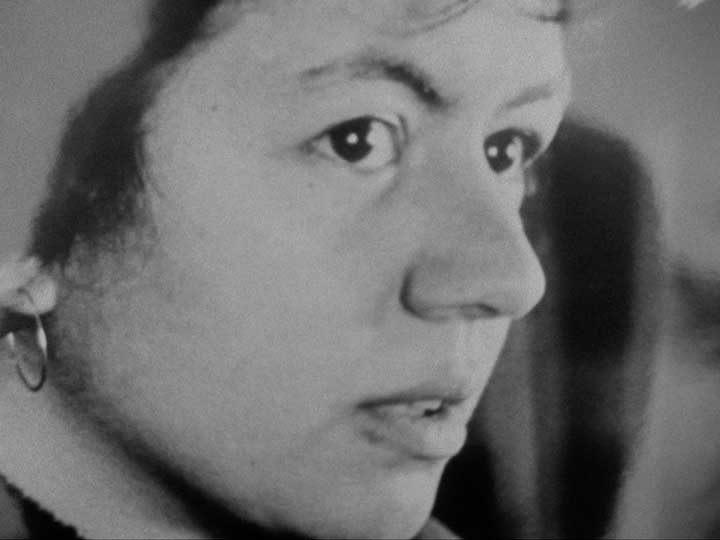
Jane Brakhage (1975)
"Recogí a Stan y Jane Brakhage en el aeropuerto y los llevé al San Francisco State College, donde Stan habló de sus películas al alumnado. Jane me fascinó. Se interesaba mucho por el mundo que la rodeaba, mientras que Stan sólo parecía concentrado en sus ideas. Recogía semillas de árboles y plantas y me dijo que había escrito un léxico del lenguaje canino. Era mucho más compleja que el retrato que hace Stan de ella en Window Water Baby Moving (1958), así que decidí hacer un documental sobre ella para mi proyecto de graduación". - Barbara Hammer
“I picked up Stan and Jane Brakhage at the airport and drove them to San Francisco State College where Stan spoke about his films to the student body. I was fascinated with Jane. She was so interested in the world around her while Stan seemed caught up only in his ideas. She picked seed pods from trees and plants and told me she had written a lexicon of dog language. She was so much more complex than Stan’s portrayal of her in Window Water Baby Moving (1958) that I decided to make a documentary about her for my graduate project.” — Barbara Hammer
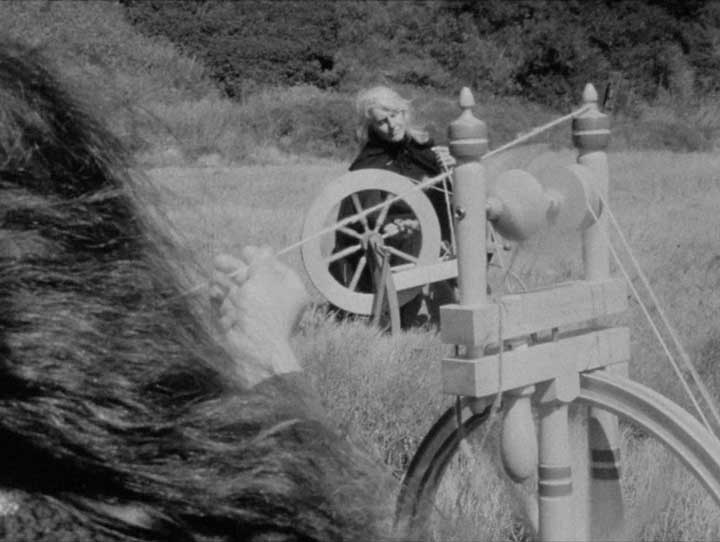
The Great Goddess (1977)
Un niño, dos jóvenes, una madre y tres crones hacen girar espirales, uniendo rituales de nacimiento, muerte y renacimiento. Rodada en Mendocino, California, donde la serpiente de agua aparecía cada día de rodaje, donde el río inundaba la espiral de arena, donde tierra, aire, fuego y agua se encontraban.
A child, two youths, a mother and three crones spin spirals, joining rituals of birth, death and rebirth. Filmed in Mendocino, California, where the water snake appeared on each shooting day, where the river flooded the sand spiral, where earth, air, fire and water met.
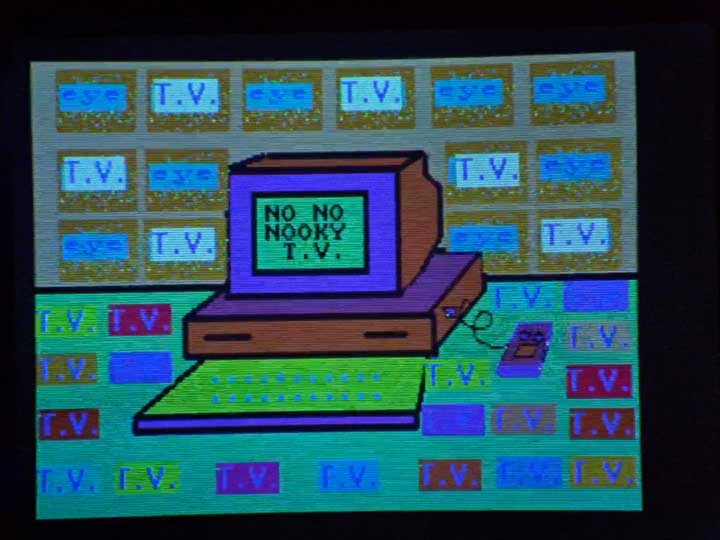
No No Nooky T.V. (1987)
Utilizando una Bolex de 16 mm y un ordenador Amiga, Hammer crea una película ingeniosa e impactante sobre cómo las mujeres ven su sexualidad frente a la forma en que se perciben las imágenes masculinas de las mujeres y el sexo. El impacto de la tecnología en la sexualidad, las emociones y el yo sensual se explora a través del lenguaje informático yuxtapuesto al lenguaje coloquial cotidiano del sexo. No Nooky T.V. confronta la controversia feminista en torno a la sexualidad con el lenguaje electrónico, los píxeles y la interfaz. Incluso el monitor se erotiza en este híbrido de película y vídeo que se burla del romance, la sexualidad y el amor en nuestra era postindustrial.
Using a 16mm Bolex and Amiga computer, Hammer creates a witty and stunning film about how women view their sexuality versus the way male images of women and sex are perceived. The impact of technology on sexuality and emotion and the sensual self is explored through computer language juxtaposed with everyday colloquial language of sex. No No Nooky T.V. confronts the feminist controversy around sexuality with electronic language, pixels and interface. Even the monitor is eroticized in this film/video hybrid that points fun at romance, sexuality, and love in our post-industrial age.
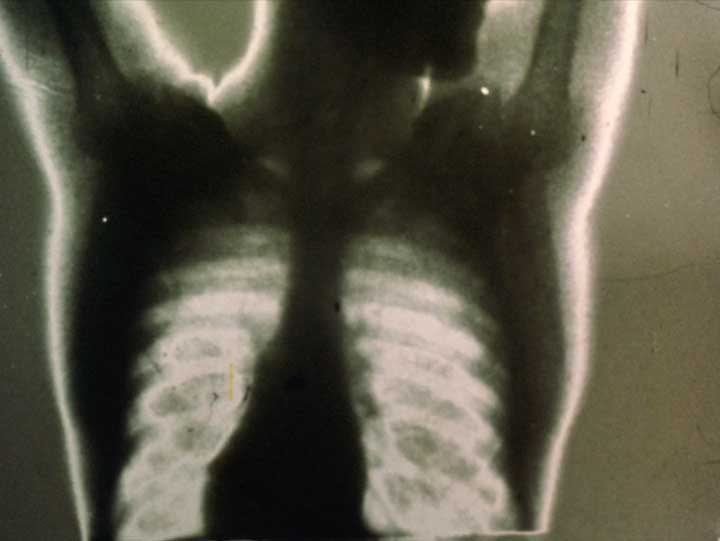
Sanctus (1990)
SANCTUS es una película de radiografías en movimiento refotografiadas, filmadas originalmente por el Dr. James Sibley Watson y sus colegas. Haciendo visible lo invisible, la película revela la estructura esquelética del cuerpo humano al tiempo que protege la fragilidad oculta de los sistemas orgánicos interiores.
Escribe Hammer: "Al hacer SANCTUS me preocupaban las cualidades contradictorias de belleza y peligro de las imágenes que se producían por la radiación. Me deleitaba con las imágenes y, al mismo tiempo, imaginaba los efectos nocivos de la creación de imágenes en los sujetos. Este fue mi dilema al hacer la película y continúa hasta hoy. Confío en la intuición del espectador de un presentimiento, una sensación de ambivalencia, un estado emotivo inestable no homogéneo, un no saber".
SANCTUS is a film of rephotographed moving x-rays, originally shot by Dr. James Sibley Watson and his colleagues. Making the invisible visible, the film reveals the skeletal structure of the human body as it protects the hidden fragility of interior organ systems.
Writes Hammer: "In making SANCTUS I was concerned about the contradictory qualities of beauty and danger of the images that were made by radiation. I delighted in the imagery and at the same time I imagined the deleterious effects of the image making on the subjects. This was my dilemma in making the film and continues until today. I rely on the viewers' intuition of a foreboding, a sense of ambivalence, an unsteady non-homogenous emotive state, a not-knowing."