
CINEINFINITO / Centro Cultural Doctor Madrazo
Viernes 28 de Abril de 2023, 19:00h. Centro Cultural Doctor Madrazo
Calle Casimiro Sainz, s/n

Programa:
– Honoré Nicolas (2015), 16mm, b&n, silente, 4 min.
– Porquerolles (2019), 16mm/video, b&n y color, silente, 18 min.
– Passaporta (2020-2021),16mm, color, silente, 11 min.
– Dansaert (2020-2021), 16mm, color, silente, 27 min.
Formato de proyección: HD (nuevos 2K scan)
Agradecimiento especial a Nicky Hamlyn y Light Cone
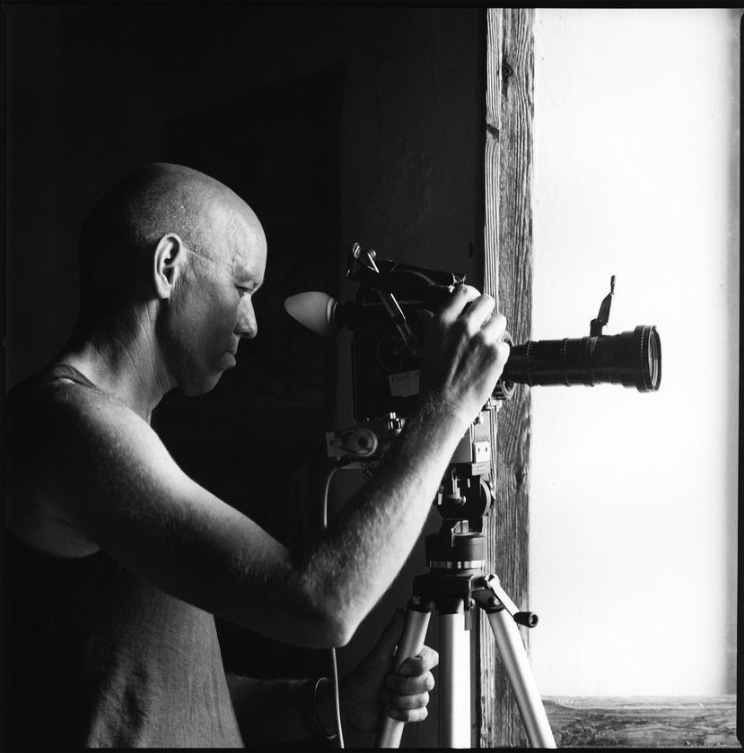
Nicky Hamlyn es un cineasta, artista y escritor británico que trabaja en el cine estructural. Ha hecho películas durante más de tres décadas. Su obra explora los elementos básicos de la experiencia cinematográfica: la relación entre espacio fílmico y encuadre, entre tiempo, vibración óptica y movimiento, y entre la luz y la imagen material. Ha escrito para la revista Film Quarterly y ha publicado los libros Film Art Phenomena y Kurt Kren: Structuralist Films (con Simon Payn y A.L. Rees), y más recientemente Experimental and Expanded Animation: New Perspectives (Palgrave, 2018). Organizó talleres para la London Film-Makers’ Co-op a finales de los años 70.
Hamlyn se licenció en Bellas Artes por la Universidad de Reading en 1976 y actualmente da clases de cine y vídeo experimental en la University for the Creative Arts de Canterbury, y es profesor asociado en el Máster de Comunicación Visual del Royal College of Art de Londres. Los campos de especialidad de Hamlyn son el cine y vídeo experimental, y la teoría visual.
Una selección de las películas de Hamlyn, junto a las de otro colega, el cineasta y escritor Andrew Kotting, se proyectó en 2008 en The George Rodger Gallery en Maidstone (Kent).
Se han realizado proyecciones de sus obras en el Royal College of Art (Londres, 2006) y en los festivales de cine de Nueva York y Toronto (2007).
Se le han dedicado sesiones monográficas en la Cinematheque de San Farncisco, Pacific Film Archive (Berkeley) y Double Negative (Montreal, 2007).
En noviembre de 2009, Hamlyn proyectó películas en Unit B9, The Powerhub. Se trata de una antigua planta de automoción situada junto al río Medway en Maidstone, visible desde la estación de ferrocarril de Maidstone East. Su trabajo se mostró en conjunción con el de otros artistas emergentes, como el fotógrafo Sebastian Edge. La obra se tituló 5-9, y su objetivo era captar la luz desde el crepúsculo hasta la noche en el paisaje industrializado de esta parte del río. Toda la obra estaba concebida para proyectarse en las ventanas de la galería, para que pudiera verse desde la pasarela peatonal que cruza desde la estación de ferrocarril, y también desde el interior del edificio.
En su obra más reciente, producida gracias a una residencia artística en Toronto, Hamlyn ha tratado de explorar y afinar la relación entre la cámara y lo profílmico. Todas sus películas son silentes, y están hechas fotograma a fotograma, a la manera de la animación, incluyendo paisajes rurales y urbanos e interiores domésticos.
Nicky Hamlyn is a British filmmaker, artist and published author working in Structural film. He has been making films for three decades. His work explores the basic elements of the filmic experience: the relationship between film space and the film frame, between time, flicker and movement, and between light and the material image. He has contributed to Film Quarterly and has published Film Art Phenomena and Kurt Kren: Structuralist Films (with Simon Payn and A.L. Rees) and most recently Experimental and Expanded Animation: New Perspectives (Palgrave, 2018). He was workshop organizer for the London Film-Makers’ Co-op in the late 1970s.
Hamlyn graduated in fine art from the University of Reading in 1976 and is currently a professor of Experimental Film and Video at the University for the Creative Arts in Canterbury, and Lecturer in Visual Communication MA at the Royal College of Art in London. Hamlyn specialises in experimental film and video arts and visual theory.
Hamlyn exhibited films with a colleague, the film director and writer Andrew Kotting in 2008 at The George Rodger Gallery in Maidstone, Kent.
Screenings of his work have taken place at the Royal College of Art, London (2006) and the New York and Toronto International Film Festivals (2007).
He has had one-person shows at San Francisco Cinematheque, Pacific Film Archive, Berkeley and Double Negative, Montreal (2007).
In November 2009, Hamlyn exhibited films in Unit B9, The Powerhub. This is a former commercial vehicles factory, situated by the river Medway in Maidstone and viewable from Maidstone East railway station. He exhibited in conjunction with a number of emerging artists including the photographer artist, Sebastian Edge. The work was entitled 5-9, intended to exploit the dusk to night time light of the semi-industrial urban landscape on this part of the river. All the work was designed to be projected onto the windows of the gallery, and could be viewed from the railway footbridge opposite, as well as from inside the building.
In his most recent work, produced on an artist’s residency in Toronto, Hamlyn has been concerned with exploring and trying to refine the relationship between the camera and its profilmic. All the films are silent and have been made frame by frame, in the manner of animation, and include rural and urban landscapes and domestic interiors.
Honoré Nicolas (2015)
Honoré Nicolas (película de 16 mm, en blanco y negro, silente, 5 minutos, 2015), es un estudio de un jardín en Arles (Provenza), filmado durante una semana desde la misma posición de cámara y montado completamente en cámara. La cortina, que oculta una puerta cochera, baila indómita al compás del viento Mistral.
Honoré Nicolas, 16mm film, B&W, silent, 5minutes, 2015, is a study of a garden in Arles, Provence, shot over a one week period from the same camera position, and edited entirely in-camera. The curtain, which conceals a car-port, dances wildly to the Mistral wind.

Porquerolles (2019)
La primera parte contiene permutaciones de todos los planos posibles a partir de fotogramas con combinaciones de seis bloques de piedra, dispuestos en círculo en un terreno de la isla de Porquerolles, cerca de Hyères. Las secciones siguientes incluyen un estilo de improvisación más libre, y bucles animados de tres fotogramas generados a partir de secciones recortadas de un solo jpeg de una de las piedras. La parte final es una secuencia de fundidos encadenados de capturas de pantalla tomadas de imágenes de satélite.
The first part permutates all the shots possible from framings of combinations of six stone blocks, in a circle in a field on the island of Porquerolles, near Hyères. Subsequent sections are more freely improvised or consist of animated, three-frame loops generated from cropped sections of a single jpeg of one of the stones. The final part is a sequence of dissolves of screen-shots taken from satellite images of the location.


Passaporta (2020-2021)
Un estudio cronológico de la vista desde una única ventana sobre el lucernario de Passaporta, una librería de Bruselas. Filmado a lo largo de dieciocho meses, con amplio uso del time-lapse. La obra se basa en la afirmación de Siegfried Kracauer de que nunca podemos agotar el campo de visión.
A chronological study of the view from a single window onto the skylight of Passaporta, a bookshop in Brussels. Shot over eighteen months and making extensive use of time-lapse filming. The work is underpinned by Siegfried Kracauer’s assertion that we can never exhaust the field of view.

Dansaert (2020-2021)
Un estudio cronológico de la vista desde una única ventana, filmado a lo largo de dieciocho meses, con amplio uso del time-lapse. La obra se basa en la afirmación de Siegfried Kracauer de que nunca podemos agotar el campo de visión.
A chronological study of the view from a single window, shot over eighteen months and making extensive use of time-lapse filming. The work is underpinned by Siegfried Kracauer’s assertion that we can never exhaust the field of view.


Traducción de textos: Javier Oliva